

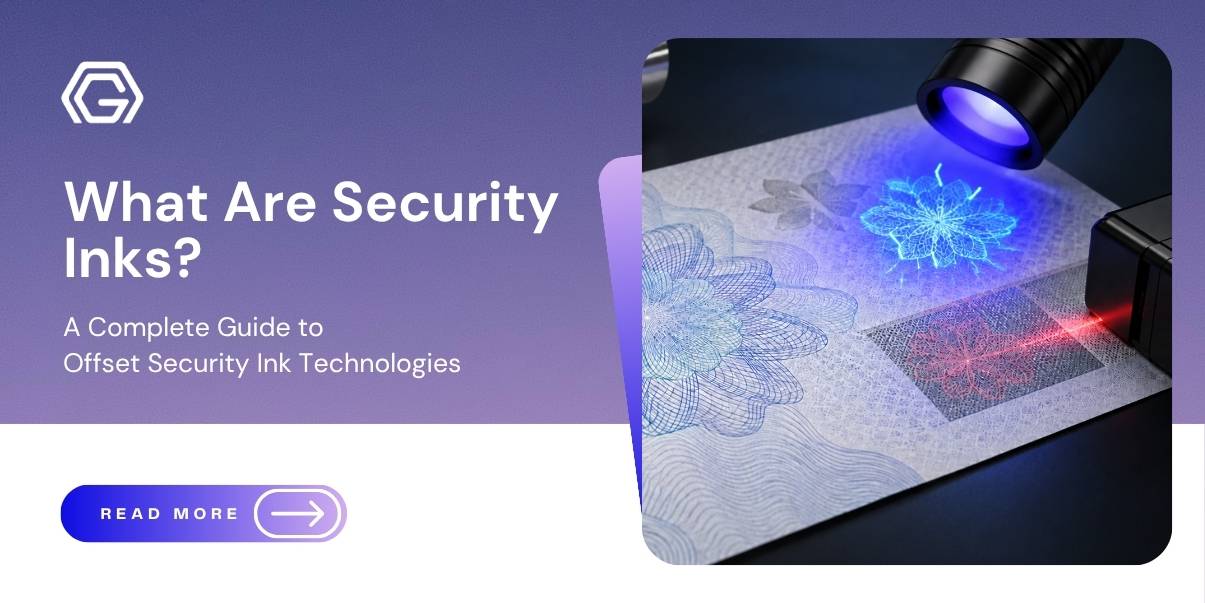
An ordinary printed colour provides limited security on its own because its visible appearance can often be measured and approximated using conventional printing systems. A security ink incorporates a verifiable optical, chemical, magnetic or machine-readable response into the printed feature—for example fluorescence under a specified UV source, infrared absorption or reflection, thermochromic colour change within a defined temperature range, or a visible reaction to solvents and other alteration agents, a reversible or irreversible colour change within a specified temperature range. Without a verifiable material response, the ink itself is not a functional security ink, although the printed design may still incorporate security through features such as microtext, guilloché patterns or controlled registration.
What Security Inks Are and Why Counterfeiting Makes Them Necessary
Counterfeiting responds to margin: the OECD and EUIPO estimated global trade in counterfeit goods at approximately USD 467 billion in 2021, equivalent to 2.3% of global imports. Security features raise the cost a convincing copy demands and expose the gap at a checkpoint.
No ink does this alone. A secure document is a stack: watermark and thread in the substrate; guilloche, microprinting and latent images in the design; intaglio and numbering in the process. Security inks form one layer within this system and interact with the substrate, document design and printing process, and no single ink technology prevents every form of counterfeiting.
Overt, Covert and Forensic: The Three Levels of Authentication
Level 1, overt. Checked by anyone with no tool: a cashier tilting a note, a consumer warming a thermochromic patch. It helps users detect crude forgeries.
Level 2, covert. A simple tool in trained hands: a teller’s 365 nm lamp, a customs officer’s IR viewer. Not readily apparent under normal viewing conditions and verified using a specified tool, so it may not be captured in an ordinary photograph.
Level 3, forensic. Examined by trained specialists using spectroscopy, microscopy or taggant analysis; its evidential value depends on the validated method, reference samples, documentation and chain of custody.
Why Offset Lithography Is Widely Used in High-Volume Security Printing
Offset holds the fine line work security design depends on: guilloche rosettes, hairline rules and microtext survive the plate, blanket and sheet path. Multi-unit presses provide repeatable register and consistent reproduction, while high throughput and low unit cost make offset suitable for long runs.
Security Ink Requirements for Offset: Ink-Water Balance, Tack and Rheology
In wet offset, image and non-image areas share one plane, separated chemically, so ink and dampening solution must stay in balance; excessive dampening solution can over-emulsify the ink, while an incorrect ink–water balance can cause toning, scumming and unstable transfer. Tack sits in a narrow window: too high it can pick fibres or damage the substrate surface, while too low it can produce weak or unstable transfer and poor trapping.
What reaches the sheet is a fraction of what leaves the duct, far thinner than a screen deposit, and the functional response has to come from inside that thin film. Adding pigment is no cure, since pigment loading is itself bounded by rheology, water pickup and transfer behaviour.
Substrate Interaction: How Paper and Polymer Decide the Drying System
On absorbent paper and board, conventional sheet-fed offset inks typically set partly by vehicle penetration and subsequently dry by oxidative polymerisation, so the film develops after printing rather than on press. Most non-porous polymer substrates provide little or no absorptive setting, so suitably formulated UV-curable inks are often preferred; adhesion and cure must still be verified on the actual substrate.
UV curing is a drying mechanism; UV fluorescence is an authentication response. One product can be both, which is why the terms get confused.
Security Ink Families and Printing Options: UV, IR, Visible, Thermochromic and Screen
Visible inks. Visible fluorescent security inks have a defined daylight colour and also fluoresce under specified UV excitation; fade resistance depends on the pigment, binder, substrate and exposure conditions, so one element is checked by eye and by lamp.
UV fluorescent inks. Pale in daylight, luminous under excitation, since absorbed energy is partly lost non-radiatively and the emitted photon takes the longer wavelength. UV offset security inks covers 365 nm, 254 nm and multi-fluorescent types.
IR inks. IR security inks may be verified through wavelength-selective infrared absorption, reflection or luminescence using an appropriate filtered detector. Anti-Stokes up-conversion inks form a distinct luminescent class that converts lower-energy excitation into higher-energy emission. Anti-Stokes converts low energy infrared photons into visible light and needs a dedicated source.
Thermochromic inks. Many reversible thermochromic inks use microencapsulated leuco-dye systems containing a colour former, developer and temperature-sensitive solvent; heating can make them colourless or shift their colour. Other thermochromic systems operate through different mechanisms. Thermochromic inks are reversible, with hysteresis, or irreversible.
Screen printing inks. Offset gives a thin film, screen a thick one. Screen printing security inks run at high viscosity, carry UV or IR pigment, and cover paper, plastic and metal.
Multi-Layer Authentication: Why Layering Beats Maximising One Feature
Buying the most exotic covert feature and stopping is a common error: a feature nobody can check protects nothing. A sound specification selects overt, covert and forensic features according to the threat model, authorised users, inspection equipment and required assurance level; not every application requires all three. The print sequence is defined for the specific ink systems, substrate and press configuration; covert inks do not inherently require a dedicated unit, and numbering may be applied in a separate production stage, an opaque or spectrally absorbing overprint can attenuate the excitation or emitted light and reduce the readability of an underlying fluorescent layer.
Where Security Inks Are Used: Banknotes, ID Documents, Tax Stamps, Packaging
Banknotes and security paper remain the hardest case; passports and ID cards require resistance appropriate to their specified service life, while bank cards may combine printed covert features with physical and electronic security mechanisms. Tax stamps and excise labels pair an overt retail check with covert markers for enforcement. Certificates, tickets and brand protection labels complete the range.
How to Specify a Security Ink: Substrate, Press, Verification, Durability
Five questions decide it: the substrate, since its absorbency, surface energy and chemical compatibility influence the drying or curing system and adhesion; the press, its unit count and whether UV curing is fitted; the verification equipment already in the field, because an unreadable feature is decoration; durability over the document’s life; and control of the ink supply itself. The offset security inks portfolio is organised around these choices; Nanografi, founded in METU Technopolis, Ankara, formulates inside them.
Frequently Asked Questions About Security Inks
Can security inks run on a standard offset press?
Yes, provided the ink is formulated for the specific sheetfed or web-offset system and the press has the required curing equipment and compatible components. The practical limits are unit count, whether UV curing is fitted, and the dampening stability. Highly functional or heavily pigmented security inks may have a narrower operating window for ink–water balance, tack and transfer, making correct roller condition and press settings especially important.
What is the difference between UV fluorescent ink and UV curing ink?
UV fluorescence is an authentication response: the ink emits visible light under ultraviolet. UV curing is a drying process where UV energy triggers photoinitiators that polymerise the wet film. One product can be both, which is why tenders confuse the two.
How many security features should one document carry?
No fixed number, but the number and combination of overt, covert and forensic features should be determined by the threat model, document value, authorised users and available verification infrastructure. Document value and inspection infrastructure decide the rest.
Do security inks work on plastic cards and polymer substrates?
Yes, but the drying system changes. Non-porous substrates provide little or no absorptive setting; conventional oxidative inks may still dry if specifically formulated, but setting, adhesion and set-off can be problematic. UV-curable offset inks are therefore commonly used, subject to substrate and cure compatibility, since the film polymerises in place. Test adhesion before committing to production.
How long does a printed security feature stay verifiable?
It depends on pigment chemistry, ink film, substrate and the conditions the document lives through. Fluorescent responses can weaken under prolonged light exposure, and abrasion is a real factor for cards and passports. State the expected service life at the enquiry stage.
What should we send a supplier when requesting a security ink?
Substrate samples, press type and unit count, the authentication levels you want, and the verification devices already in the field. Add run length, expected lifetime and any handling conditions. That drives the chemistry far more than a colour target does.
Key Takeaways on Offset Security Ink Technologies
Security inks earn their place by adding a response or material property that can be verified, not merely by adding colour. Offset remains the practical carrier for that response at volume, and the formulation has to deliver it from inside a very thin transferred film while maintaining a stable ink–water balance during printing. A field-ready specification uses an application-appropriate combination of overt, covert and, where required, forensic features, each matched to its authorised user and verification method. Substrate and existing verification infrastructure decide the rest. You can explore the full offset security inks range or contact Nanografi Inks to match a formulation to your substrate, press and verification setup.
References
OECD/EUIPO, Mapping Global Trade in Fakes 2025, OECD Publishing, Paris. https://www.oecd.org/en/publications/mapping-global-trade-in-fakes-2025_94d3b29f-en.html
IUPAC, Compendium of Chemical Terminology (Gold Book), entry "fluorescence" (F02453). https://goldbook.iupac.org/terms/view/F02453
CIE, International Lighting Vocabulary, 2nd edition (CIE S 017:2020). https://cie.co.at/publications/international-lighting-vocabulary
Choosing a Security Ink for Your Print Programme?
UV, IR, visible, thermochromic and screen printing security inks formulated for offset production on paper, plastic and polycarbonate substrates. Send us your substrate samples, press configuration and the verification devices already in the field, and our formulation team will match the chemistry to them.