

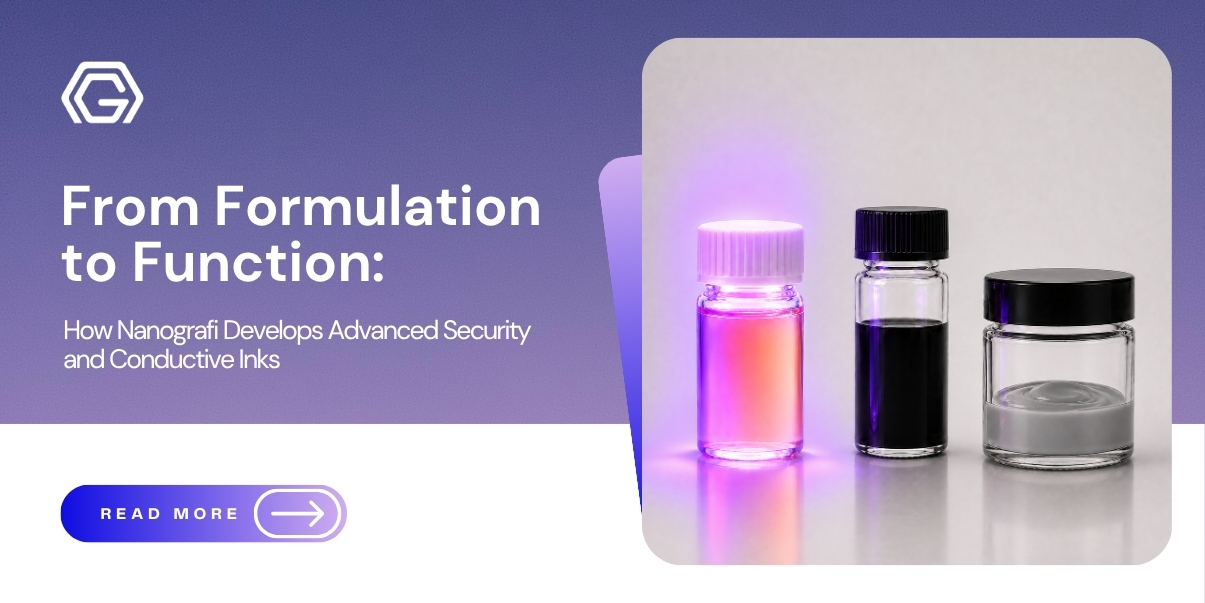
Printing technologies are no longer limited to transferring color onto a surface. In advanced applications, a printed layer may need to remain invisible under normal light, respond to a defined UV or IR wavelength, change color with temperature or conduct electrical current.
In these systems, ink becomes more than a printing material. It becomes an engineered functional layer.
This approach forms the basis of Nanografi Inks, where nanomaterial expertise, formulation chemistry and industrial printing requirements are brought together to develop security and functional ink systems.
Founded at METU Technopolis, Nanografi serves more than 100 countries across advanced materials, energy, chemicals, healthcare, engineering and brand-protection technologies. The Nanografi Inks portfolio is a direct extension of this broader materials-science and R&D infrastructure.
From Advanced Materials to Industrial Ink Systems
Nanografi’s journey in ink technologies begins with advanced materials.
Materials such as graphene, carbon nanotubes, metallic particles and functional pigments can demonstrate valuable properties including electrical conductivity, fluorescence or wavelength-specific optical behavior. However, these properties alone are not enough for an industrial printing application.
The active material must also be dispersed into a stable formulation, deposited uniformly, cured under controlled conditions and converted into a durable film without losing its intended functionality.
This transition from material to application requires several technical disciplines to work together:
- Nanomaterial selection and surface chemistry
- Particle dispersion and formulation stability
- Viscosity and rheology control
- Substrate compatibility
- Sintering, drying, and curing behavior
- Optical, electrical and mechanical testing
- Production scale-up and quality control
Nanografi Inks therefore approaches each product as a complete formulation system rather than a simple mixture of pigments and binders.
The portfolio is built around four priorities: security, functional precision, scalability and process integration. Its formulations are designed to deliver stability, consistency and reproducibility across industrial printing environments.
Development Starts with the Application
Every ink-development project begins with the intended use.
A security ink for a passport has different requirements from a conductive paste for a printed sensor. Even two inks within the same product family may require different chemistry depending on the substrate, printing method or production conditions.
Before formulation work begins, Nanografi evaluates parameters such as:
- Substrate type and surface properties
- Printing and deposition method
- Required viscosity and flow behavior
- Drying, curing, or sintering mechanism
- Target film thickness
- Adhesion and durability
- Optical or electrical performance
- Detection conditions
- Operating and environmental requirements
This application-driven approach helps ensure that the formulation is designed around measurable technical criteria rather than adapted from a standard product after development.
A Four-Stage Development Process
Nanografi follows a structured process consisting of four main stages:
Research, Formulation Design, Testing and Validation, and Production and Support.
1. Research and Requirement Definition
The research stage converts the customer’s application into a technical performance framework.
For security inks, this may include the required excitation wavelength, emission color, visibility conditions, IR response, detection method and resistance to copying or scanning.
For conductive inks, the main parameters may include electrical conductivity, sheet resistance, film continuity, adhesion, mechanical flexibility and long-term stability.
The printing method is also evaluated at this stage. Offset printing, screen printing and coating processes expose the ink to different shear forces and require different rheological characteristics.
The objective is to define how the ink must behave before determining what the formulation should contain.
2. Formulation Design
An advanced ink generally contains several interacting components:
- Functional pigments or conductive materials
- Polymer binders
- Solvents or reactive diluents
- Dispersing and wetting agents
- Photoinitiators, catalysts, and drying agents
- Rheology modifiers
- Adhesion promoters
- Stabilizers and processing additives
Each component can influence several properties at the same time.
Increasing the concentration of conductive particles may improve electrical performance, but it can also increase viscosity or reduce print definition. A strong binder may improve adhesion while limiting flexibility. A fluorescent pigment may provide the correct optical response but lose stability if it is incompatible with the curing system.
For this reason, formulation development is a balancing process. Nanografi customizes the chemistry according to substrate, curing behavior, functionality and processing conditions.
Security Inks: Engineering Controlled Optical Responses
Security printing requires features that are difficult to reproduce through conventional printing, scanning or copying methods.
Nanografi’s security portfolio includes UV-responsive, IR-responsive, visible, invisible, thermochromic, UV-curing and oxidative-drying systems.
These technologies are developed for applications such as banknotes, passports, certificates, tax stamps, identity documents, labels and brand-protection systems.
UV Security Inks
UV-responsive inks contain photoluminescent components that absorb ultraviolet radiation and emit visible light.
Depending on the formulation, the printed feature may remain invisible under daylight and become detectable under:
- 365 nm long-wave UV
- 254 nm short-wave UV
- 302 nm excitation
- Multiple fluorescent detection conditions
Nanografi’s portfolio also includes bi- and tri-fluorescent systems that can generate more than one authentication response within the same printed feature.
The technical challenge is not only producing fluorescence. The formulation must maintain emission intensity, print definition, adhesion and stability after curing and throughout the product lifecycle.
IR and Up-Conversion Systems
IR security inks provide covert authentication through infrared absorption, reflection or wavelength conversion.
These systems may remain undetectable under normal lighting and become visible only through a dedicated reader or controlled illumination source.
Stokes, anti-Stokes and up-conversion emission mechanisms offer different relationships between excitation and emission energy. These mechanisms make the resulting security feature more difficult to imitate using conventional pigments.
Stable particle dispersion and controlled film thickness are essential because variations in concentration can alter the optical signal and reduce detection consistency.
UV-Curing and Oxidative-Drying Inks
The curing mechanism is selected according to the substrate and printing environment.
UV-curing inks polymerize rapidly under ultraviolet exposure. They are suitable for polymeric substrates and support fast production, strong adhesion and durable film formation. Functional variations may include IR, invisible, visible and thermochromic properties.
Oxidative-drying inks are optimized for paper and porous substrates. Their drying process is based on oxidation and absorption, making them suitable for conventional offset applications such as banknotes, certificates, legal documents and security seals.
The same security pigment may behave differently in each system. Binder chemistry, surface interaction and pigment stability must therefore be adapted to the intended production process.
Grafen Nokta: Authentication Directly on the Product
Nanografi’s security portfolio also extends beyond documents and packaging.
Grafen Nokta is an invisible marking technology developed for direct application to material surfaces, particularly precious metals such as gold and silver.
The technology forms a permanent, highly durable nanolayer that can be detected under photoluminescence under UV excitation visibly altering the appearance or structural integrity of the metal. It can support authentication and traceability in precious metals, jewelry, luxury goods, packaging and other components requiring covert verification.
This represents an important direction in brand protection: the security feature becomes part of the product itself rather than remaining limited to the outer label or packaging.
Functional Inks: Printed Layers That Conduct and Perform
Functional inks are designed to carry out a physical or electrical task.
In printed electronics, the ink may operate as a conductor, electrode, sensor element or current collector. The printed layer must therefore combine electrical performance with stable film formation and mechanical durability.
Nanografi’s conductive portfolio includes carbon inks and pastes, silver paste and carbon-nanotube-based formulations.
Carbon Inks and Pastes
Carbon-based systems provide a balance of conductivity, chemical resistance, durability and cost efficiency.
They can be used in printed circuits, sensors, resistive components and electrode structures. Their performance depends on carbon loading, particle size distribution, dispersion quality and the continuity of the conductive network formed after drying.
Poor dispersion can create agglomerates, local resistance differences and weak points in the printed film. Dispersion control is therefore a critical stage of development.
Silver Paste
Silver formulations are selected where high conductivity and low contact resistance are required.
The final electrical performance depends on several factors, including silver concentration, particle distribution, binder content, curing and/or sintering profile and film thickness.
Silver pastes can support printed circuits, sensors, battery components and energy systems requiring consistent current flow.
Carbon Nanotube Pastes
Carbon nanotubes combine electrical conductivity with high aspect ratio and mechanical strength.
Their structure allows conductive networks to form at relatively low loading levels. However, nanotubes can agglomerate easily, making dispersion chemistry one of the main technical challenges.
When properly formulated, CNT pastes can be used in flexible electronics, advanced sensors and energy-storage components requiring lightweight and mechanically durable conductive films.
Nanografi’s conductive ink portfolio is developed around electrical conductivity, film integrity, adhesion, flexibility and printing-process stability.
Testing the Final Printed Film
A stable liquid formulation is not automatically a successful industrial ink.
The material must also perform after printing, curing/drying and interaction with the substrate. For this reason, Nanografi evaluates both the liquid ink and the resulting printed film.
Depending on the application, validation may include:
- Viscosity and rheological stability
- Dispersion and sedimentation behavior
- Print definition and film uniformity
- Adhesion and abrasion resistance
- Electrical conductivity and resistance
- Mechanical flexibility
- Curing and drying behavior
- UV and IR response
- Detection repeatability
- Lamination compatibility
- Environmental and chemical durability
Nanografi’s security solutions also emphasize multiple detection technologies, customizable colors, rub resistance, resistance to photocopying and scanning, and quality assurance.
The objective is to confirm that the required functionality remains consistent across the printed area, production batches and intended lifecycle.
From Laboratory Scale to Industrial Production
Scale-up is one of the most important stages in advanced ink development.
Increasing the production volume changes mixing energy, heat generation, particle wetting, dispersion time and batch homogeneity. A formulation that performs well in a laboratory mixer may not behave in exactly the same way during larger-scale manufacturing.
Nanografi manages this transition through controlled process parameters, quality-control procedures and batch verification.
Technical support also continues during integration into the customer’s production environment. Printing equipment, substrate treatment and curing/drying conditions may all require application-specific adjustment.
This development model is designed to preserve reproducibility, stability and measurable performance from laboratory formulation to industrial use.
From Nanomaterial Expertise to Printed Performance
Nanografi Inks brings security and functional technologies together within a shared materials-development framework.
Although security and conductive inks serve different applications, both depend on the same fundamental principles:
- Controlled particle dispersion
- Stable formulation chemistry
- Substrate compatibility
- Reproducible film formation
- Application-specific curing/drying
- Measurable performance
- Industrial scalability
From wavelength-specific authentication and invisible product marking to printed circuits, sensors and energy components, Nanografi develops ink systems that are designed to perform under real production conditions.
This is the journey from nanomaterials to print: transforming the intrinsic properties of advanced materials into stable, measurable and scalable industrial functionality.
Nanografi’s strong R&D infrastructure, long-standing expertise in advanced materials and scalable production capabilities form the foundation of the Nanografi Inks portfolio. From formulation development and dispersion control to performance validation and process optimization, each stage is carried out according to application requirements and measurable technical criteria. During the transition from laboratory studies to industrial production, quality control, batch consistency and process reproducibility remain key priorities. This integrated structure enables security and functional inks to deliver stable, reliable and sustainable performance not only under controlled test conditions, but also in real printing and production environments. By combining advanced material know-how with application-specific technical support and industrial manufacturing experience, Nanografi Inks provides comprehensive solutions for the security, traceability and functionality needs of different industries.
Looking for the Raw Materials Behind Our Conductive Inks?
Silver nanoparticles, graphene powders, carbon nanotubes, and MXene precursors form the foundation of our conductive ink formulations. Browse Nanografi's full catalog of advanced materials for your R&D and production needs.