

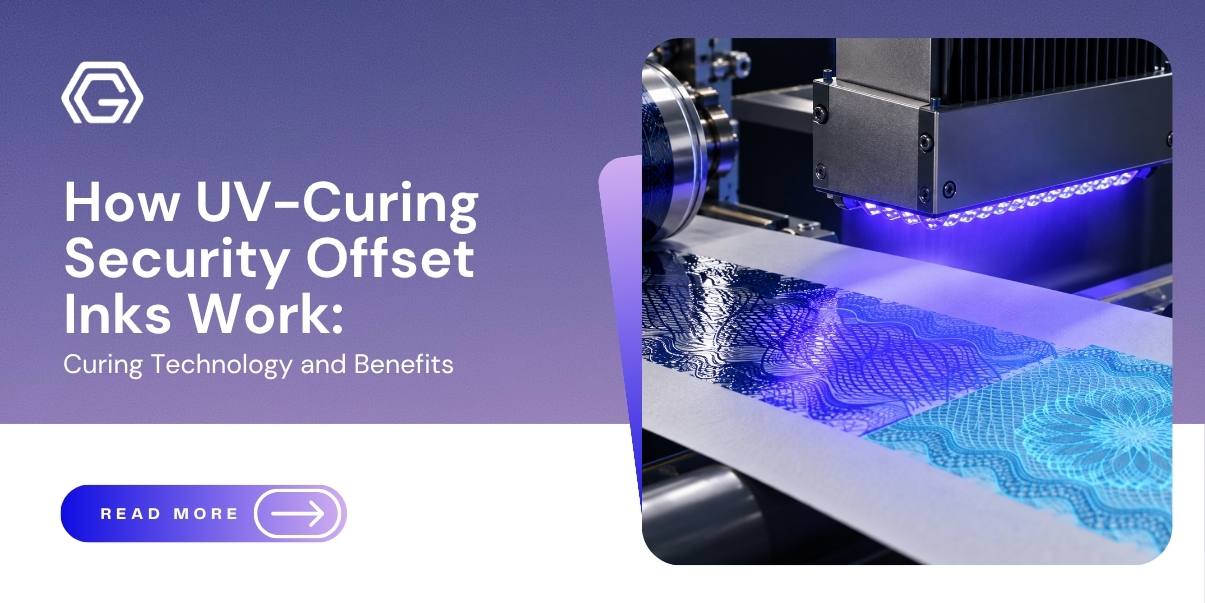
A UV-curing security offset ink is an offset ink whose film is converted from liquid to solid by a photochemical reaction triggered by ultraviolet energy on press, rather than by solvent evaporation, absorption into the substrate or oxidation in air, and which may carry functional security pigments, dyes or other security additives within the cured film. Hardening and authentication live in the same layer.
UV Curing vs Oxidative Drying: How the Two Offset Ink Systems Differ
A conventional oxidative offset ink loses part of its vehicle into the porous substrate, and the resin left behind reacts with oxygen, so the film develops after printing, over an interval set by substrate, film weight and plant conditions. A UV ink has essentially no evaporating solvent; the reactive monomers and oligomers present before exposure polymerise and crosslink to form a solid network, so a properly cured film is generally ready for handling as the sheet leaves the curing unit.
What Is in a UV-Curable Security Ink: Oligomers, Monomers, Photoinitiators
Oligomers form the principal binder backbone and strongly influence hardness, flexibility, adhesion and chemical resistance, together with monomer functionality, crosslink density and degree of cure. Low-viscosity reactive monomers, often referred to as reactive diluents, adjust viscosity and rheology to suit ink transfer on the press, but they polymerise into the network rather than leaving it, so changing their type or concentration affects both rheology and the properties of the cured polymer network. Pigments and security additives, fluorescent and up-conversion included, give the optical response; photoinitiators absorb radiation within suitable wavelength ranges and generate the reactive species that initiate polymerisation; stabilisers, waxes and surfactants govern shelf life, slip and wetting. None of it is chosen alone, as ink formulation development shows: increasing pigment or security-additive loading can increase UV absorption or scattering where its spectrum overlaps the curing system, reducing cure depth; it can also alter viscosity, tack, ink–water balance and transfer, depending on the pigment, surface treatment, dispersion and binder system.
How UV Curing Works: Photoinitiator Activation, Free Radicals, Crosslinking
In a free-radical UV-curing system, the photoinitiator absorbs radiation within its absorption band and, depending on its chemistry, either undergoes unimolecular cleavage or forms initiating radicals through hydrogen abstraction or electron-transfer reactions with a suitable co-initiator. Radicals attack acrylate double bonds, chains propagate, and when the formulation contains multifunctional monomers and oligomers, propagation between multiple reactive sites produces a crosslinked three-dimensional network. Conversion is generally incomplete under practical curing conditions, and the unreacted material affects the film’s properties.
Key irradiation variables include the spectral overlap between the source output and photoinitiator absorption, irradiance at the ink surface and energy density, defined as irradiance integrated over exposure time. Exposure time is governed primarily by press speed and the effective irradiated length in the direction of travel. Dose and irradiance are not interchangeable: the competing rates of initiation, propagation, termination and oxygen diffusion depend on how fast energy arrives, and reflector condition and source geometry can affect both the irradiance profile and the delivered dose, while working distance often changes peak irradiance more strongly than total energy density.
Cure Depth: Pigment Absorption, Ink Film Thickness and Oxygen Inhibition
Pigments can absorb, scatter or reflect incident curing radiation, with the magnitude and spectral character of this effect depending on pigment chemistry, particle size, concentration and dispersion. Some fluorescent components may absorb within spectral regions that overlap the photoinitiator absorption band and therefore compete for curing radiation. Up-conversion security materials, however, are commonly excited by near-infrared radiation and do not necessarily compete directly with the photoinitiator for incident UV radiation. A heavily pigmented or strongly absorbing formulation can therefore be more difficult to cure through than a clear varnish under the same irradiation conditions, particularly when the colorant or security additive absorbs or scatters wavelengths required by the photoinitiator.
Film thickness presents two distinct challenges: attenuation through the film reduces the radiation reaching its lower regions, while oxygen at the air–ink interface can quench excited photoinitiators and scavenge reactive radicals, inhibiting surface cure. A film with a solid body but a tacky surface may indicate oxygen inhibition, insufficient surface irradiance or inadequate spectral matching. A film that feels hard but fails a tape or fold test may indicate inadequate through-cure or interfacial cure; however, poor substrate wetting, low surface energy, contamination, excessive cure shrinkage, brittleness or insufficient cohesive strength should also be considered.
Mercury UV Lamps vs UV LED Curing Systems
A mercury arc lamp emits broadband UV including short wavelengths, aiding surface cure. A UV LED curing array emits a narrow spectral band centred commonly at 365, 385, 395 or 405 nm; the first three fall within the CIE UV-A range of 315–400 nm, whereas 405 nm lies just outside it in the visible violet region. UV LED systems switch on and off almost instantaneously and generally transfer less radiative heat to the substrate than mercury-vapour systems because they emit negligible infrared radiation, although they should not be regarded as entirely cold. A photoinitiator package formulated for broadband mercury output may cure inefficiently or fail under a narrow-band LED source if its absorption spectrum does not overlap sufficiently with the LED emission; the UV-B and UV-C wavelengths available from the mercury system are generally absent from typical UV-A/UVV LED systems.
Substrate Compatibility, Ink Adhesion and Rub Resistance of UV-Cured Films
UV curing is what opens non-porous substrates: conventional oxidative inks generally dry more slowly and may show adhesion or set-off problems on plastics and polymer cards unless specifically formulated for these substrates, which puts ID card and polycarbonate and bank card work on the UV side of the offset security inks portfolio. Adhesion there depends on surface energy, so corona pretreatment is often needed, while heat-sensitive films make thermal load critical.
Adhesion, rub and scuff resistance, chemical and solvent resistance follow from crosslink density, earned by a cured network rather than the label. Sheets leave the press handleable, so numbering, die-cutting, laminating and personalisation start sooner with less set-off, which often decides tax stamps and excise and product and brand protection specifications.
Conventional Offset Ink vs UV-Curing Offset Ink: Comparison Table
| Criterion | Conventional Offset Ink | UV-Curing Offset Ink |
|---|---|---|
| Drying mechanism | Absorption plus oxidation | Photoinitiated crosslinking under UV |
| Time to handleable film | Develops in the pile | Handleable after adequate UV exposure |
| Substrate suitability | Paper, porous stock | Paper and non-porous substrates, including plastics and polymer cards |
| Post-print handling | Facility practice decides | Numbering, die-cutting, laminating sooner |
| Energy and equipment | No curing units | Curing units, power, cooling |
| Consumables and press setup | Standard rollers and washes | UV-compatible rollers and washes |
| Security integration | IR, invisible, visible | Long wave, short wave, multi-fluorescent, up-conversion |
| Typical Nanografi use | Paper-based security documents | Plastic and polymer substrates |
UV-Curing vs UV-Visible Authentication: Two Different Meanings of UV
UV curing describes how the ink hardens; UV fluorescence describes how a printed feature answers an inspection lamp. A UV offset security ink may fluoresce when excited under 365 nm or 254 nm UV light, whichever way it dries, while a UV-curing security offset ink carrying those pigments does both, which is where tender documents blur the two.
Implementation Considerations Before Switching a Press to UV Curing
The press needs curing units plus rollers, blankets and washes compatible with UV chemistry. Presses running both systems need changeover discipline; cross-contamination can cause curing, drying, ink-transfer or print-quality problems. Uncured ink handling is an operator safety matter, and substrates should be qualified by testing. UV curing is not simply better than conventional: for many paper-based documents the oxidative system stays the appropriate, less complex answer.
Frequently Asked Questions About UV-Curing Offset Inks
How quickly does a UV-curing offset ink cure?
Curing happens as the sheet passes under the lamp, so the film is functionally complete at the delivery rather than in the pile. Behaviour depends on lamp output, irradiance, press speed, film thickness and pigment loading, so no figure fits every job.
Do UV-curing inks work on non-porous substrates?
Yes, and it is a main reason to use them. Curing does not rely on absorption, so plastics and polymer cards become viable without relying on substrate absorption, whereas conventional oxidative inks may dry more slowly and show adhesion or set-off problems unless specifically formulated for these substrates. Adhesion still comes from surface energy and pretreatment.
What is the difference between a UV ink and a UV-curable ink?
In common usage a UV ink reveals a feature under an inspection lamp, an authentication property, while a UV-curable ink hardens under UV on press, a manufacturing property. One product can be both, since a UV-curing formulation may carry fluorescent pigments.
Can a standard offset press run UV inks?
Not without modification. It needs UV curing units of adequate output and correct position, plus rollers, blankets and washes compatible with UV chemistry, with power and cooling considered. A press alternating between conventional and UV work also needs disciplined changeover.
Why is a UV ink tacky on the surface after curing?
Usually oxygen inhibition at the air interface: oxygen scavenges radicals, so the top layers stay under-polymerised, often alongside weak surface irradiance. Check lamp output, reflector condition and lamp distance before touching the ink. A film that feels hard but shows poor adhesion may indicate inadequate interfacial cure, insufficient wetting, low surface energy, contamination, cure shrinkage or incompatibility between the ink and substrate.
Can UV-curing inks carry security features?
Yes, that is their purpose here. Long wave and short wave fluorescent, multi-fluorescent and up-conversion components sit in the cured film, providing covert responses for inspection with the appropriate excitation source, including on non-porous substrates for which UV curing may offer processing advantages. Fluorescent pigments may compete with the photoinitiator for curing radiation when their absorption bands overlap; up-conversion materials, which are commonly excited in the near-infrared, do not necessarily compete directly for incident UV photons.
Key Takeaways on UV-Curing Security Offset Inks
UV curing changes when the ink film becomes solid, not what the ink authenticates. That single shift opens non-porous substrates, shortens the gap between printing and finishing, and builds resistance properties into a crosslinked network. It also creates a harder formulation problem, because some security pigments and additives may absorb or scatter radiation within the spectral region required by the photoinitiator, making spectral matching and through-cure more challenging. Treat cure depth, adhesion and press configuration as design inputs rather than as things to be checked after the first production run. You can review the full Nanografi offset security inks portfolio to see how the UV-curing and oxidative-drying systems are positioned across document, card and brand-protection applications.
References
- C. Decker, “Kinetic Study and New Applications of UV Radiation Curing”, Macromolecular Rapid Communications, 23(18), 2002. https://onlinelibrary.wiley.com/doi/10.1002/marc.200290014
- CIE, International Lighting Vocabulary, 2nd edition (CIE S 017:2020), spectral band definitions UV-A 315 to 400 nm, UV-B 280 to 315 nm, UV-C 100 to 280 nm. https://cie.co.at/publications/international-lighting-vocabulary
- IUPAC, Compendium of Chemical Terminology (Gold Book), entry “fluorescence” (F02453). https://goldbook.iupac.org/terms/view/F02453
Specifying a UV-Curing Security Offset Ink for Your Press?
Long wave and short wave fluorescent, multi-fluorescent and up-conversion systems formulated for UV curing on paper, plastic and polycarbonate substrates. Share your substrate, press and detection requirements and our formulation team will work through cure depth, adhesion and spectral matching with you.