

ID Card and Polycarbonate
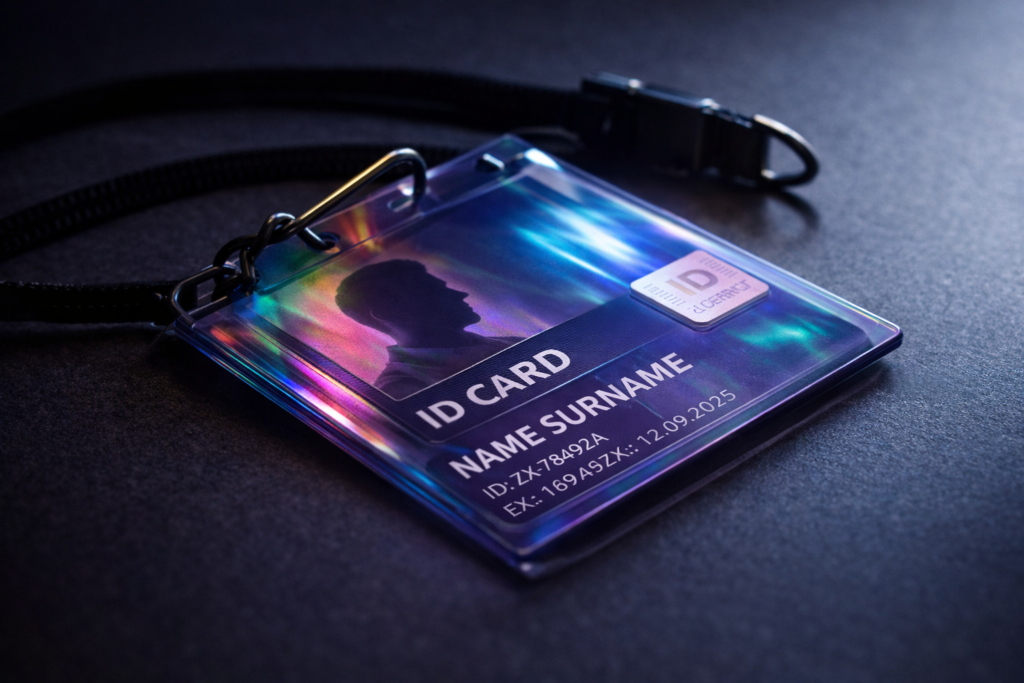
From paper-plastic hybrids to full polymer cards, ID applications rely on Nanografi Inks for offset printing, reliable bonding, and layered security. Multi-fluorescent additives and heat-resistant formulations withstand lamination and laser personalization, ensuring tamper resistance and lasting durability. Additionally, up-conversion nanostructures introduce invisible markers detectable only under specific light conditions, offering heightened protection for passport data pages and advanced ID cards.
ID Card and Polycarbonate Security Ink Solutions:
Contact Us
Request a sample, ask for detailed technical information, or explore a formulation matched to your own application.
- UV Curing Security Inks
The Security Challenge
National ID cards, residence permits and polycarbonate data pages are inspected far more often than passports — at bank counters, notaries, employers, police checks and increasingly at automated kiosks — and they are expected to last five to ten years. Unlike a banknote, an ID document is usually examined by someone with no security training and no equipment beyond a desk lamp.
Polycarbonate adds a second constraint. The card is built from layers fused under heat and pressure, so anything printed into it has to survive lamination without shifting, clouding or losing its response. An ink that performs well on paper will not necessarily behave the same way inside a fused polymer stack.
How Nanografi Security Inks Are Used
Because the substrate is polymer, UV curing security offset inks are the working system: they polymerise under ultraviolet exposure, adhere strongly to plastic and polymer surfaces, and cure fast enough to hold registration on high-speed card production.
Layered within that system:
- UV offset security inks provide covert fluorescence at 365 nm and 254 nm, including bi- and tri-fluorescent responses that differ by wavelength.
- IR security inks give a machine-readable check outside the visible spectrum, based on infrared absorption or reflection.
- Visible inks carry the guilloche patterns, backgrounds and design elements that make an unaltered card recognisable at a glance.
Nanografi inks are suitable for polycarbonate data pages as well as card bodies, which is why the same ink family often covers a national ID programme and the passport data page within it.
Why Security Inks Are Used Here
- Covert verification with a simple UV lamp — no reader and no training required for a first-line check.
- Lamination-friendly behaviour and rub resistance, so the feature survives fusing and years of handling.
- Adhesion on polymer substrates, where paper-optimised inks do not perform.
- Multi-detection — one reproduction method is not enough to defeat the document.
- Fogra certification and quality assurance across the Nanografi security ink portfolio.
Related Technologies and Industries
ID card programmes sit within government and security document work. Closely related applications include passport and visa printing and bank card printing.
Technologies applied here: UV curing security offset inks, UV offset security inks, IR security inks and visible inks. See the full offset security ink portfolio or browse all security printing applications.
Card construction, lamination process and the verification workflow in the field all shape the right specification. Send us the details below and our technical team will respond with the relevant ink options.
CONTACT
Discuss Your Application
Tell us about your substrate, printing system and verification requirements, and our technical team will come back with the relevant ink options.