

Passport and Visa
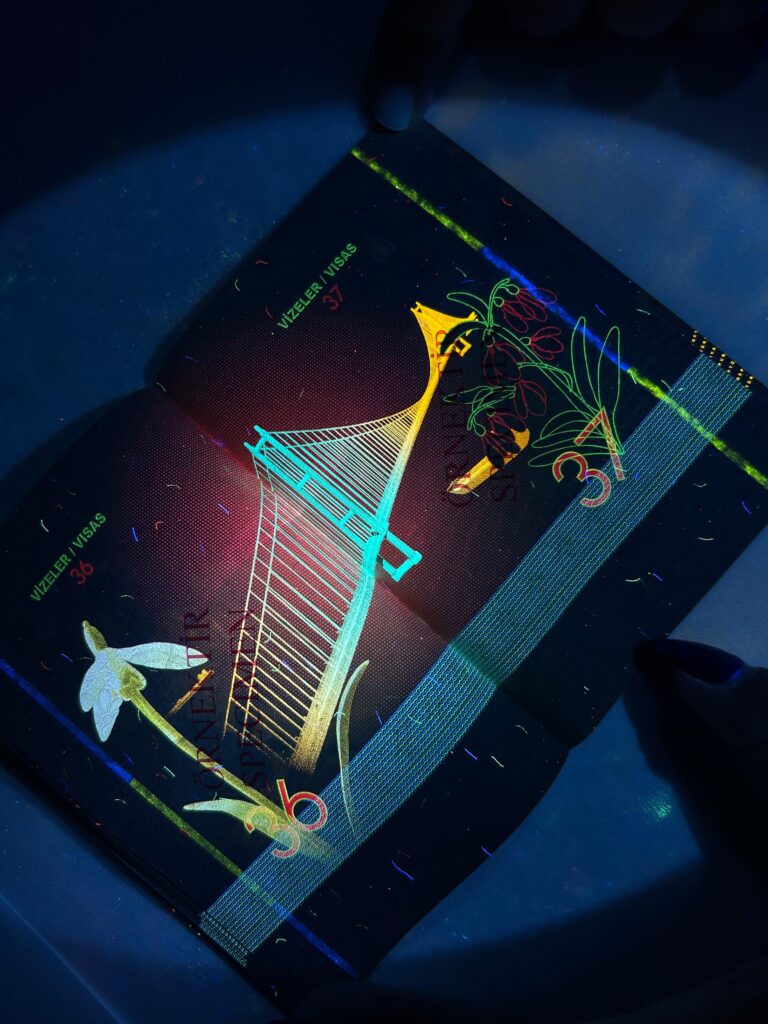
Nanografi Inks for passport and visa printing are formulated for high-definition offset processes and can include multiple security features—such as UV fluorescence (long-wave/short-wave), IR absorption, uv curing and visible security inks. This combination ensures each passport page or visa sticker contains covert elements that are exceedingly difficult to replicate, supporting robust authentication.
Nanografi Inks are suitable for passport sheets, visa pages and polycarbonate data pages.
Contact Us
Request a sample, ask for detailed technical information, or explore a formulation matched to your own application.
Passport and Visa Security Ink Solutions:
- UV Offset Security Inks
- IR Security Inks
- Visible Inks
- UV Curing Security Inks
The Security Challenge
Passports and visas are among the most heavily attacked documents in circulation. Border control operates under time pressure, often with nothing more than a handheld UV lamp or an IR reader at the desk, so a travel document has to be verifiable in seconds — by an officer, by an automated gate, and later in a forensic laboratory if a case is disputed.
At the same time the document has to survive a decade of handling: folding, humidity, lamination and repeated machine reading. That produces two requirements pulling against each other. The security features must be difficult to reproduce with commercially available inks and printing equipment, and they must stay stable and readable for the document’s full validity period. Ink selection is where those two requirements meet.
How Nanografi Security Inks Are Used
A passport is not protected by a single ink but by layers that verify in different ways:
- Overt features — visible security inks carry the printed design of the page and hold colour fidelity at high offset print speeds.
- Covert features — UV offset security inks remain invisible under daylight and fluoresce under long-wave (365 nm) or short-wave (254 nm) illumination. Bi- and tri-fluorescent formulations emit differently at different wavelengths, so one printed element can carry more than one check.
- Machine-readable features — IR security inks work through infrared absorption or reflection and sit outside the visible spectrum. Anti-Stokes and Stokes formulations are verified with an IR reader rather than by eye.
- Polymer data pages — polycarbonate and other polymer surfaces call for UV curing security offset inks, which polymerise under UV exposure to form a stable film with fast drying and minimal set-off.
Because the substrate changes between a paper visa page and a polycarbonate data page, the ink system changes with it: oxidative-drying formulations for paper, UV-curing formulations for polymer.
Why Security Inks Are Used Here
- Covert verification without added hardware cost — a UV lamp is enough for a first-line check at the border.
- Layered authentication — overt, covert and machine-readable features on the same page raise the cost of a convincing forgery.
- Resistance to photocopying and scanning — fluorescent and infrared responses do not survive reproduction on a copier or scanner.
- Durability — rub resistance and lamination-friendly behaviour matter on a document handled for ten years.
- Fogra certification and quality assurance across the Nanografi security ink portfolio.
Related Technologies and Industries
Passport and visa programmes sit within government and security document work. Closely related applications include ID card and polycarbonate documents and documents of value.
Technologies applied here: UV offset security inks, IR security inks, visible inks and UV curing security offset inks. See the full offset security ink portfolio or browse all security printing applications.
Every travel document programme has its own substrate, printing system and verification workflow. Send us the details below and our technical team will come back with the relevant ink options.
CONTACT
Discuss Your Application
Tell us about your substrate, printing system and verification requirements, and our technical team will come back with the relevant ink options.