
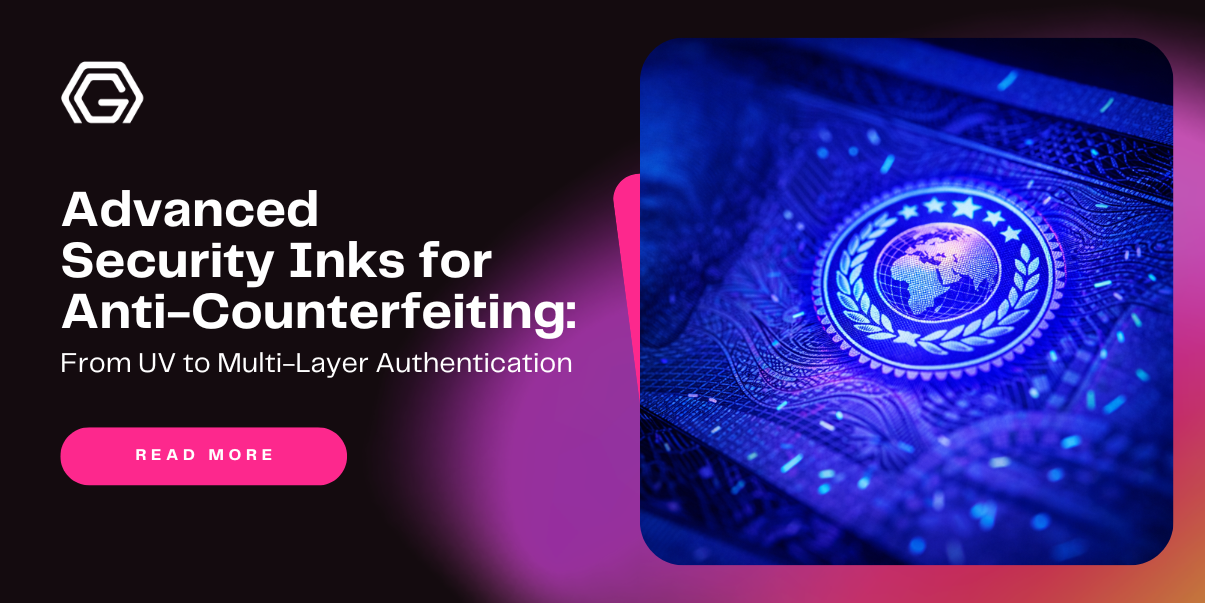
Counterfeiting is becoming increasingly sophisticated as access to high-resolution printing technologies and digital replication tools expands. Traditional security features such as holograms or basic watermarks are no longer sufficient on their own. As a result, security inks have evolved into one of the most critical components in modern anti-counterfeiting strategies, enabling multi-layer authentication systems that are significantly more difficult to replicate.
Today, security inks are not just visual markers—they are engineered materials designed to interact with light, environment, and detection systems in controlled and predictable ways.
What Are Security Inks?
Security inks are specialized formulations used in secure printing applications such as passports, banknotes, ID cards, certificates, and brand protection labels. Unlike conventional inks, they are designed to exhibit specific responses under defined conditions, including ultraviolet (UV), infrared (IR), or other external stimuli.
These inks serve multiple purposes:
- Prevent unauthorized reproduction
- Enable fast and reliable authentication
- Support multi-level verification systems
- Maintain compatibility with industrial printing processes
Recent research highlights the integration of advanced materials such as organic fluorophores, rare-earth compounds, and nanomaterials to enhance optical performance and durability.
From Single-Layer to Multi-Layer Security
One of the most important shifts in anti-counterfeiting technology is the transition from single-layer to multi-layer security systems. In the past, a single UV-reactive ink might have been sufficient. However, modern counterfeiters can often replicate such features using commercially available tools.
To address this, security strategies now rely on layered authentication:
- Overt features: Visible elements for quick human verification
- Covert features: UV or IR-responsive inks for controlled inspection
- Forensic features: Advanced markers requiring specialized equipment
Security inks play a unique role because they can operate across all three layers simultaneously. Multi-spectral inks, for example, can respond differently under UV and IR light, creating multiple checkpoints within a single printed element.
UV, IR, and Beyond: Expanding the Functional Spectrum
UV and IR security inks remain the most widely used technologies in secure printing. UV inks typically fluoresce under specific wavelengths such as 365 nm or 254 nm, enabling quick and efficient validation. IR inks, on the other hand, can either absorb or reflect infrared radiation, making them suitable for machine-readable authentication systems.
However, recent advancements go beyond these traditional approaches:
- Multi-spectral inks: Respond to multiple wavelengths simultaneously
- Photochromic inks: Change color when exposed to light
- Thermochromic inks: React to temperature variations
- Persistent luminescent systems: Continue emitting light after excitation
These developments significantly increase the complexity of replication, as counterfeiters must now reproduce multiple physical and chemical properties rather than a single visual effect.
The Role of Nanotechnology in Security Inks
Nanotechnology is playing an increasingly important role in the development of next-generation security inks. Quantum dots, carbon-based nanomaterials, and nano-engineered pigments enable precise control over emission wavelengths, intensity, and stability.
For example:
- Quantum dots provide tunable fluorescence with high color purity
- Carbon dots offer low toxicity and strong luminescence
- Nano-structured pigments improve resistance to environmental degradation
These materials allow for highly customized ink formulations that are difficult to reverse-engineer, strengthening the overall security architecture.
Ensuring Consistency in High-Volume Production
In addition to security performance, consistency is a critical factor in real-world applications. Identity documents and banknotes are produced at large scales, and even minor variations in color or response can lead to verification errors.
Recent studies demonstrate that advanced modeling techniques, including physics-informed machine learning, can optimize print consistency and color accuracy in security printing. This ensures that each printed document maintains the same authentication characteristics, which is essential for both human and machine-based verification systems.
Future Outlook: Toward Intelligent Security Materials
The future of security inks lies in the development of intelligent and responsive materials. Instead of acting as passive features, next-generation inks are expected to actively interact with their environment and provide real-time feedback.
Emerging innovations include:
- Tamper-detection inks that reveal chemical or mechanical interference
- Self-healing materials that maintain structural integrity over time
- Environment-responsive systems that adapt to external conditions
These advancements indicate a shift toward dynamic security systems, where inks become active components of the authentication process rather than static design elements.
Conclusion
As counterfeiting techniques continue to evolve, security inks are becoming more sophisticated, moving from simple UV markers to complex, multi-layer authentication systems. Their ability to combine optical, chemical, and material-based properties makes them indispensable in modern anti-counterfeiting strategies.
From UV and IR technologies to nano-engineered and multi-spectral systems, security inks are redefining how authenticity is verified. In an environment where trust is increasingly tied to verifiable identity and secure documentation, these materials are not just supporting elements—they are at the core of next-generation security design.
To explore advanced security ink solutions tailored for identity documents, secure printing, and anti-counterfeiting applications, visit our Nanografi Security Inks portfolio and discover how multi-layer authentication systems can be integrated into your production processes.