

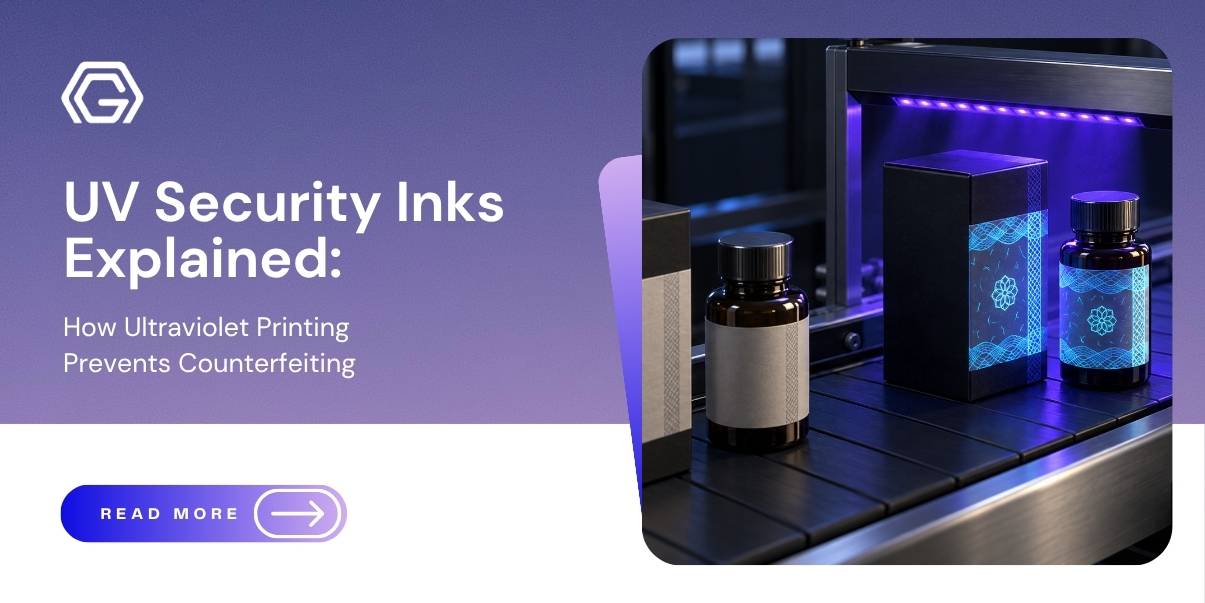
A UV security ink is a printing ink carrying fluorescent pigments that absorb ultraviolet radiation and re-emit part of that energy as visible light. In daylight the printed element can look pale or effectively absent; under a UV lamp at the specified wavelength it emits a defined colour. No ink stops forgery by itself. A UV feature raises the technical and economic cost of a convincing copy and gives an inspector a fast, repeatable check.
How UV Fluorescence Works: Excitation, Emission and the Stokes Shift
Fluorescence begins when a fluorescent species absorbs a photon and reaches an excited electronic state. Before fluorescence occurs, part of the absorbed energy is typically lost through non-radiative relaxation processes, including vibrational relaxation and interactions with the surrounding matrix. Consequently, the fluorescence emission generally occurs at lower energy and longer wavelengths than the absorption. The spectral separation between the absorption and emission band maxima is known as the Stokes shift. In appropriately selected fluorophores, this energy difference places the emission in the visible region, producing colours such as blue, green or red under ultraviolet excitation.
In near-invisible formulations, the fluorescent colorant is selected to absorb strongly in the ultraviolet while absorbing only weakly in the visible region. When pigment loading, film thickness and light scattering are also controlled, the printed feature causes little change to the substrate’s appearance under normal illumination.
Excitation Wavelength vs Emission Wavelength
An ink described only as "UV" is under-specified. A fluorescent formulation is characterised by its excitation spectrum and emission spectrum, including the excitation band used for verification and the resulting emission colour. These properties are related through the photophysical characteristics of the fluorescent material and cannot be selected independently. Two inks can be excited by the same UV source yet produce different emission colours. Verification instructions should therefore specify both the excitation source or wavelength band and the expected emission colour.
365 nm Long-Wave UV vs 254 nm Short-Wave UV: Which Is Used for Verification?
Under the CIE spectral band definitions, 365 nm is UV-A and 254 nm UV-C. The practical difference is availability: long-wave UV lamps are generally inexpensive and widely available, so 365 nm is commonly used for field verification. Short-wave sources are less commonly used than 365 nm sources, which can increase the covert value of a 254 nm-responsive feature. A counterfeiter who does not inspect the original under 254 nm may fail to detect and reproduce that response. Short-wave equipment needs controlled handling, so operator safety belongs in the procedure.
Bi-, Tri- and Quatro-Fluorescent Inks: Why Multi-Wavelength Systems Resist Copying
A single glow under one lamp is a weak barrier, since fluorescent pigments are commercially available in general. Reproduction becomes more demanding when one printed element must produce specified responses under two or more defined excitation conditions. In the Nanografi product range, bi-fluorescent systems are designed to produce different fluorescent responses under 365 nm and 254 nm illumination. The terms tri-fluorescent and quatro-fluorescent denote formulations with three and four specified optical responses, respectively; the excitation source and emission colour associated with each response must be defined in the product specification. The counterfeiter must then reproduce several specified excitation–emission responses while also maintaining the required daylight appearance. The UV offset security inks range is built on this ladder.
Visible fluorescent inks form a separate family: they display a defined colour under normal illumination and additionally fluoresce under UV. When the daylight colour or printed design is itself specified as an authentication feature, the same element can support an overt visual check and a UV-assisted covert or semi-covert check. That is the logic behind the visible inks line; near-invisible systems are designed to minimise their visual contrast under normal illumination, although a faint tint, gloss or surface difference may remain detectable.
Anti-Stokes and Up-Conversion Inks: The Adjacent Covert Layer
Up-conversion is an anti-Stokes luminescence process in which a material absorbs two or more low-energy photons—commonly in the near-infrared—and emits a higher-energy photon, which may fall in the visible region. It therefore requires an IR source matched to its excitation band; the formulation should show no specified authentication response under ordinary UV illumination unless its excitation spectrum indicates otherwise. Treat it as the neighbouring covert layer described on the IR security inks page.
UV Security Ink vs UV-Curable Ink: What Is the Difference?
These terms get confused constantly. In a UV security ink, fluorescence provides an authentication response when the finished print is illuminated with the specified UV source. UV curing is a manufacturing step. During UV curing, photoinitiators absorb radiation within their effective spectral range and initiate polymerisation and, in multifunctional systems, crosslinking of the ink film. With sufficient and spectrally matched UV dose, the film reaches a handling-ready cure as it leaves the curing unit. A single product can be both, which is exactly why the words blur. UV curing security offset inks cure on press and can carry fluorescent pigments, so specify the two properties separately.
How UV Security Inks Are Verified: Lamps, Field Inspection, Machine Reading
One feature, several roles. A cashier passes a note under a counter lamp and looks for a familiar colour in a familiar place, a rapid visual check using a simple verification tool, commonly classified as a Level 2 examination where that terminology is used. A border officer may use a fixed or portable UV examination device, including a dual-wavelength source where specified, and compare the document’s response with an approved reference. Inspectors checking tax stamps and excise labels carry a portable lamp and an issued reference card. At the forensic or laboratory level, the feature may be characterised by measuring its excitation and emission spectra and comparing the results with authenticated reference material. Machine reading extends it to production, where a fixed excitation source and a filtered sensor register a response at line speed inside large product and brand protection programmes.
Design, Substrate and Durability Considerations for UV Fluorescent Printing
Placement decides usability. A fluorescent element registered to a visible feature provides a spatial reference. If its nominal position and registration tolerance are specified, a feature outside that tolerance can fail authentication even when its emission colour appears plausible. Fine positive lines and reversed-out details can appear differently under UV because their contrast depends on deposited ink-film coverage, print spreading, optical scattering and the substrate’s background fluorescence. Without a documented reference behaviour, "it glows" is not a result.
Substrate matters as much. Optical brighteners in commercial paper can produce strong blue-white fluorescence and reduce the contrast of a printed UV feature. Security substrates intended for such features are therefore commonly specified for low or controlled background fluorescence rather than assumed to be universally free of optical brighteners. Within an application-specific concentration and film-thickness range, increasing the amount of fluorescent material can increase emission intensity; at higher loadings, however, self-absorption, inner-filter effects, aggregation and concentration quenching can limit or reduce the observed fluorescence. Because offset printing deposits a relatively thin ink film, achievable fluorescence is constrained by permissible pigment loading, ink rheology, tack, ink–water balance and transfer quality. A single offset impression therefore has an application-dependent maximum usable emission intensity.
Service life matters too. Prolonged strong light causes photobleaching, and abrasion tells on a document handled for years. Because general-purpose fluorescent pigments are commercially available, a common single-wavelength response provides only limited protection when used alone; difficulty comes from layering, wavelength combinations and formulation specificity, as Nanografi’s account of advanced security inks for anti-counterfeiting sets out.
Frequently Asked Questions About UV Security Inks
What wavelength is used to verify UV security ink?
Field verification commonly uses long-wave UV illumination centred near 365 nm because suitable lamps are generally inexpensive, portable and widely available. Short-wave UV illumination near 254 nm may be specified for a less readily observable response because suitable sources are less commonly used and require more controlled handling.
Is UV security ink really invisible in normal light?
Not always, and "invisible" is closer to marketing than to physics. Near-invisible grades are formulated to absorb primarily in the ultraviolet and only weakly in the visible region. Their detectability under normal illumination also depends on pigment loading, ink-film thickness, light scattering, surface gloss and the substrate, so a faint tint or surface difference may remain visible. Visible fluorescent grades are intentionally coloured under normal illumination and additionally fluoresce under the specified UV source.
What is the difference between UV ink and UV-curable ink?
UV security ink names an authentication response: pigments emit visible light when a finished print is illuminated with ultraviolet. UV-curable ink describes a curing mechanism: photoinitiators absorb radiation within their effective spectral range and initiate polymerisation and, in multifunctional formulations, crosslinking of the ink film. One ink can do both, so specify each separately.
Can UV security inks be printed on standard offset presses?
Conventional-drying UV fluorescent inks can be printed on standard wet-offset presses when formulated for that process. UV-curable fluorescent inks require a press equipped with a compatible UV-curing system and suitable rollers, blankets and wash materials. Fluorescent pigments must sit inside the rheology, tack and ink and water balance window that wet offset allows, which constrains the usable pigment loading and ink-film thickness. Increasing pigment loading can initially increase emission, but excessive loading may reduce performance through agglomeration, self-absorption, inner-filter effects or concentration quenching. Press trials using the intended substrate and production conditions are required to verify printability, registration, daylight appearance and UV response under the tested conditions.
Can a UV feature be read by machine?
It can. A matched excitation source and spectrally filtered detector can read a fluorescent response in sorting or inspection equipment, provided that the optical system and acceptance thresholds are validated for the intended operating speed. Machine reading requires sufficient signal-to-noise ratio, stable and repeatable emission, controlled feature placement and defined tolerances for excitation, detection and print variation.
Does a UV feature stop counterfeiting on its own?
No, and it should not be specified as if it did. A common single-wavelength fluorescent response may be relatively easy to approximate using commercially available fluorescent materials and therefore provides limited protection when used alone. Security value comes from a documented combination of features, such as defined excitation–emission responses, controlled placement, specified tolerances and a substrate with suitably low or controlled background fluorescence.
Key Takeaways on UV Security Ink Authentication
UV security inks provide a rapid means of verification, while accurately reproducing a fully specified fluorescence response can be technically demanding. The strength of the feature comes from specification detail: the excitation source or wavelength band, the expected emission spectrum or colour, the minimum acceptable response, the feature’s position and registration tolerance, and the intended substrate. A single fluorescent response under a commonly available lamp provides only limited protection when used alone. A defined multi-response feature, produced under specified excitation conditions, positioned within a stated registration tolerance and applied to a substrate with low or controlled background fluorescence is substantially more demanding to reproduce accurately. Decide how the feature will be verified before choosing the ink. You can review the full offset security inks range or talk to Nanografi Inks about a specification for your paper and banknote programme.
References
IUPAC, Compendium of Chemical Terminology (Gold Book), entry "fluorescence" (F02453). https://goldbook.iupac.org/terms/view/F02453
CIE, International Lighting Vocabulary, 2nd edition (CIE S 017:2020), spectral band definitions UV-A 315 to 400 nm, UV-B 280 to 315 nm, UV-C 100 to 280 nm. https://cie.co.at/publications/international-lighting-vocabulary
Specifying a UV Security Ink for Your Document?
Long wave 365 nm, short wave 254 nm, bi-, tri- and quatro-fluorescent systems and anti-Stokes up-conversion inks, formulated for offset. Share your substrate, verification equipment and required daylight appearance, and our formulation team will work through excitation, emission and registration tolerances with you.