


Thermochromic Inks

Temperature-Responsive Security and Functional Printing Solutions

Thermochromic inks change colour when the printed surface reaches a defined activation temperature — returning to their original state as they cool, or holding the change permanently, depending on the formulation. 


How Thermochromic Security Inks Work

The colour change is produced by a microencapsulated pigment system. Each capsule holds a colour former, a developer and a temperature-sensitive medium. Below the activation temperature the colour former and the developer are bound together and the print appears coloured. When the activation temperature is reached, the medium inside the capsule changes phase, the two components separate, and the printed area loses its colour or shifts to the second colour of the design. In reversible systems the components recombine as the print cools and the original state returns; the small difference between the colour-loss and the colour-return temperature (hysteresis) is normal and is part of how the ink is designed.

A two-colour effect is achieved by printing the thermochromic layer over a permanent colour: when the thermochromic layer clears, the colour underneath becomes visible.

The thermochromic pigment is applied as a dedicated ink layer in offset or screen printing, either as a standalone security element or over or under a conventional colour.

The user compares the observed behaviour with the expected one: colour to colourless, colour A to colour B, or a hidden element becoming visible.

Contact Us

Request a sample, ask for detailed technical information, or explore a formulation matched to your own application.

Reversible vs. Irreversible Thermochromic Inks

Reversible Irreversible
Behaviour Returns to its original colour on cooling Colour change is permanent once the threshold is passed
Typical activation source Finger / body heat, ambient temperature Process heat, thermal exposure, tampering attempt
Repeatable verification Yes — unlimited checks No — single use
Primary function Field authentication Evidence of heat exposure or tampering
Typical applications Banknotes, passports, ID cards, tax stamps, brand labels Cold-chain and pharmaceutical packaging, tamper-evident labels and seals
What it proves That the item carries the genuine security feature That the item was exposed to heat or interfered with

Key Features

Defined activation temperature

The activation point is set during formulation according to the application and confirmed on printed samples.

Reversible or irreversible behaviour

Repeatable field verification, or a single permanent record of exposure — selected according to the purpose of the feature.

Flexible colour-transition design

Colour-to-colourless transitions, or colour A to colour B through layer design.

Combinable with covert layers

Can be used together with Nanografi UV, IR and invisible inks to build a multi-level overt + covert feature set.

Applications Areas​

Security inks for tax stamps and excise labels, carrying overt, covert and machine-readable verification inside the printed design.
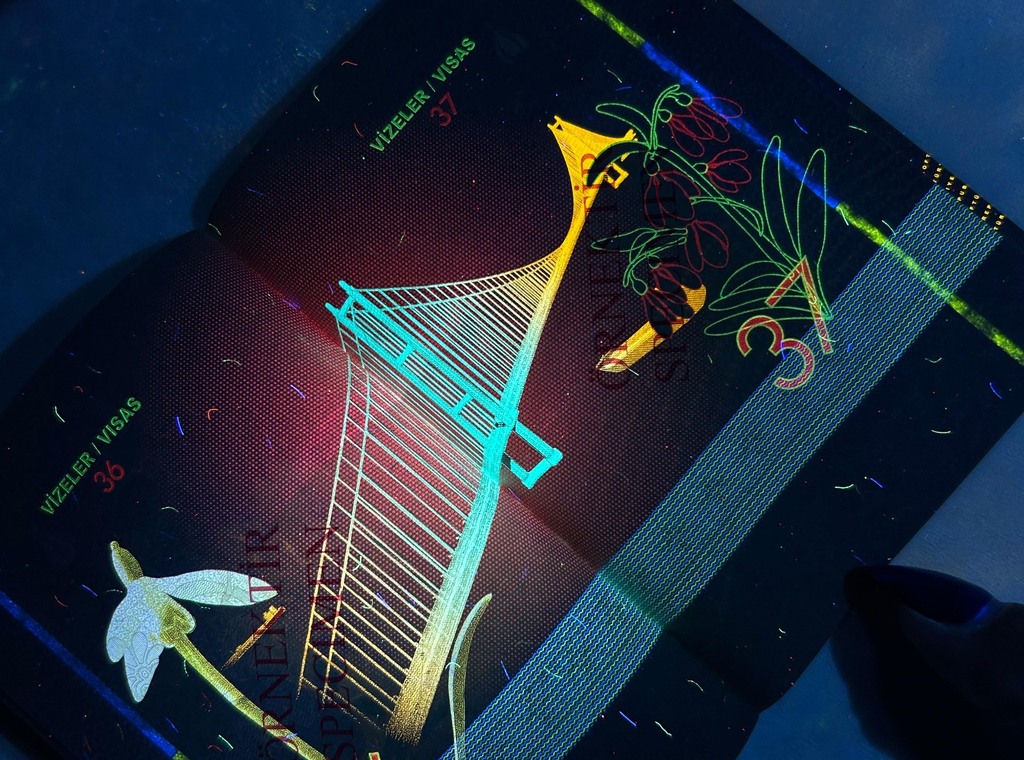
By integrating advanced UV/IR and multi-fluorescent solutions, we fortify passports and visas to uphold global travel standards without compromise.
Frequently Asked Questions

Reversible ink returns to its original colour as it cools and can be verified an unlimited number of times, which is why it is used on documents that are checked repeatedly, such as banknotes, passports and tax stamps. In irreversible ink the colour change becomes permanent once the threshold is passed, proving that the item was exposed to heat or interfered with.

The activation temperature is defined on a project basis. For document security features it is normally set so that finger contact is enough to trigger the change; in packaging and indicator applications it is set against the temperature threshold that needs to be monitored. The exact value is agreed during formulation and confirmed on printed samples.

Thermochromic inks can be formulated for different printing systems, including conventional offset and UV-curing printing. Oxidative-drying thermochromic inks are suitable for conventional offset presses, while UV-curable formulations require a compatible UV-curing printing system. The appropriate formulation should be selected according to the printing process, substrate, and curing conditions.

Yes. The thermochromic element forms the overt verification layer, while Nanografi UV and IR security inks can be applied in the same print as covert layers, creating a multi-level authentication structure.

Yes. Colour, transition behaviour and activation response are developed for the specific substrate and printing system, and approved on printed samples.

Add a Thermochromic Security Feature to Your Print

Share your application, substrate and printing system, and our technical team will define the appropriate thermochromic formulation and activation behaviour, then validate it on printed samples.


CONTACT

Discuss Your Application

Tell us about your substrate, printing system and verification requirements, and our technical team will come back with the relevant ink options.

Contact Us